Best PVC Solvent Cement: Complete Buying Guide for Leak-Proof Joints
A small drip at midnight can ruin your sleep — and your peace of mind. In most Indian homes, leaks don’t happen because of the pipe, but because of weak joints. The right PVC solvent cement ensures that leak never starts. This guide helps you choose the best glue for PVC pipe — saving time, money, and future headaches.
What Is PVC Solvent Cement?
PVC solvent cement is not an ordinary adhesive — it creates a chemical weld. It softens the surface of the pipe and fitting, and when joined together, both fuse into one solid piece. Once cured, the joint becomes as strong as the pipe itself when applied correctly.
Why Choosing the Right PVC Cement Matters
Using the wrong cement can lead to shrinkage, cracks, or joint failure — especially under harsh Indian weather conditions. High summer temperatures, pressure fluctuations, and water quality can weaken poor joints. The right cement ensures durability, prevents leaks, and maintains consistent water pressure.
Types of PVC Solvent Cement
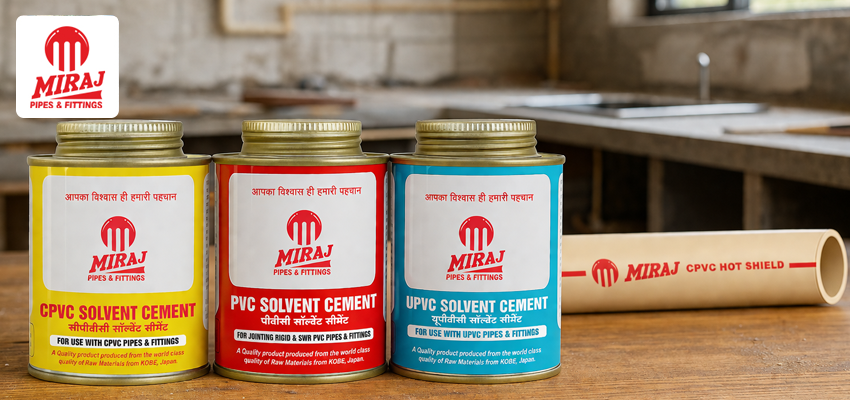
1. PVC Solvent Cement
Designed for standard PVC pipes used in cold water applications. It provides a strong, reliable bond for household plumbing, drainage systems, and general water supply lines. Suitable for small to medium diameter pipes with quick setting and dependable performance.
2. CPVC Solvent Cement
Formulated specifically for CPVC piping systems used in hot and cold water applications. It ensures excellent heat resistance and long-term durability, making it ideal for residential and commercial plumbing where temperature variations are common.
3. uPVC Solvent Cement
Engineered for rigid uPVC pipes, commonly used in outdoor and structural piping systems. It offers superior joint strength, chemical resistance, and stability, making it suitable for exposed conditions and long-term installations.
Factors to Consider When Choosing the Best Glue for PVC Pipe
1. Pipe Material (PVC, CPVC, uPVC)
Always match the cement with the pipe material. Using the wrong combination can lead to weak bonding and early failure.
2. Pipe Diameter
Smaller pipes require low-viscosity cement, while larger pipes need thicker, heavy-bodied cement for proper bonding.
3. Water Pressure Levels
High-pressure supply systems demand high-strength solvent cement. Always check pressure ratings before selection.
4. Temperature Conditions
Extreme climates — from scorching summers to colder regions — impact joint strength. Choose cement that is rated for your local temperature range.
5. Drying and Curing Time
For quick fixes, fast-setting cement works best. However, for larger systems, allow proper curing time to ensure long-term performance.
How to Apply PVC Solvent Cement Properly?
Step 1: Clean the pipe and fitting thoroughly. Remove dust, oil, and moisture.
Step 2: Apply primer if required to enhance bonding.
Step 3: Apply PVC solvent cement evenly on both surfaces.
Step 4: Join immediately and hold for at least 30 seconds to prevent push-out.
Step 5: Remove excess cement for a clean, strong joint.
Step 6: Allow proper curing time before starting water flow.
Why Choose Miraj PVC Solvent Cement?
When strength matters, Miraj delivers. Miraj PVC solvent cement is engineered for strong, leak-proof joints that withstand Indian conditions — from extreme heat to fluctuating water pressure.
Designed with precision formulation, Miraj cement creates a powerful chemical bond that ensures long-lasting durability. Whether it’s household plumbing, agricultural pipelines, or commercial installations, Miraj offers solutions that perform consistently.
The range includes fast-setting variants for quick repairs and heavy-bodied options for high-pressure applications. Each product is crafted to provide reliability, ease of application, and superior joint strength.
Mazbooti ka raaj… Miraj!
The right PVC solvent cement transforms two pieces into one strong system. Choose wisely based on pipe type, size, and environment. Apply it correctly — and enjoy a leak-free system for years. With Miraj Pipes, you don’t just build connections, you build strength that lasts.
FAQ's
Initial setting usually happens within a couple of minutes, which is enough to hold the joint in place. However, for proper strength, allow at least 2 hours before running water in small pipelines, and up to 24 hours for larger diameter or high-pressure lines.
No, each material requires its own specific solvent cement. PVC, CPVC, and uPVC have different chemical compositions, so using the wrong type can result in weak joints and leakage over time. Always match the cement to the pipe material.
Yes. A fully cured joint becomes part of the pipe and does not allow water, alkali or mild acid to pass.