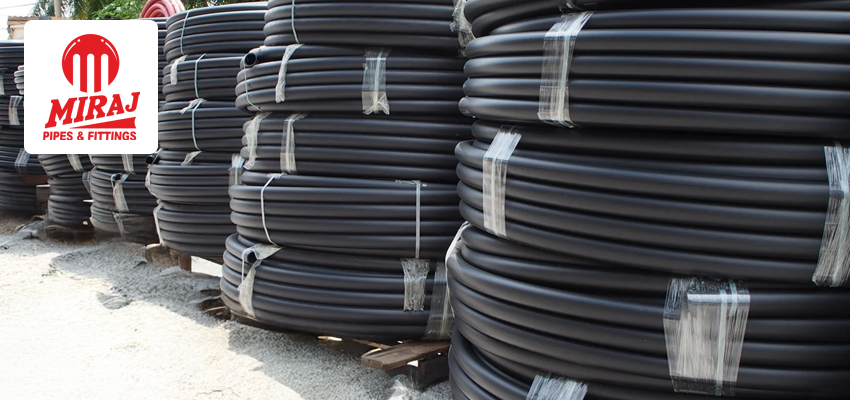
What is HDPE Pipe
If you have spent any time around construction, farming, or civil infrastructure work in India, you have almost certainly come across HDPE pipes — even if you did not know them by that name. High-Density Polyethylene (HDPE) piping has quietly become the material of choice for engineers, farmers, and municipalities across the country, and for good reason. At Miraj Pipes & Fittings, we work with these pipes every day, and we put this guide together to help you understand exactly what they are, where they are used, and why they outperform other options in most scenarios.
HDPE is a thermoplastic polymer made from ethylene. What sets it apart from other plastics is its high strength-to-density ratio — it is lightweight without being fragile. The pipes are manufactured by heating petroleum-based raw materials to high temperatures, which produces a material that handles heavy loads and significant pressure without cracking or warping. In India, you will recognise these pipes easily: smooth surface, predominantly black in colour, often carrying blue or orange strips that indicate their specific application.
How HDPE Compares to Other Plastic Pipes
One of the most common questions we get at Miraj is: "What is the actual difference between HDPE and regular plastic pipes?" It is a fair question, because from a distance they can look similar. The short answer is that HDPE is considerably more durable and flexible than most alternatives. Here is a quick breakdown:
HDPE Pipes
- Highly flexible — can bend around corners without cracking
- Joined by heat fusion, where pipe ends are melted together to form a seamless bond
- Resistant to chemicals, corrosion, and biological growth
- Ideal for underground and outdoor use
PVC Pipes
- Rigid and stiff — not suitable where ground movement is a factor
- Joined using solvent cement
- Works well for drainage and indoor water supply
CPVC Pipes
- Can handle hot water up to 93°C
- Suited for both hot and cold plumbing systems
- Higher cost than standard PVC
For most infrastructure and agricultural applications in India, HDPE is the clear winner on longevity and performance.
What Are HDPE Pipes Used For?
The versatility of HDPE is genuinely impressive. It is used across industries precisely because it handles so many different conditions without fuss. Here is where you will typically find it:
- Municipal water supply networks — leak-free performance makes it the standard for potable water distribution
- Agricultural irrigation — drip and sprinkler systems that conserve water and withstand field conditions
- Gas distribution — city gas networks rely on HDPE for its leak-proof joints
- Industrial use — transporting chemicals, slurries, and effluents safely
- Telecommunications — protective ducting for underground optical fibre cables
- Sewerage and drainage — smooth inner walls prevent blockages in gravity-flow systems
Essentially, wherever you need a conduit that will not corrode, leak, or degrade under pressure — HDPE is the answer.
Types of HDPE Pipes
Not all HDPE pipes are the same. They are graded based on material quality and pressure handling capacity. The "PE" stands for Polyethylene, and the number that follows represents the Minimum Required Strength (MRS) of the material.
-
PE63 — Entry-Level Grade
An older generation material, PE63 is suited for low-pressure applications. It is less commonly used in high-demand projects today, but still has its place in certain basic installations.
PE80 — Medium Pressure Applications
PE80 offers good crack resistance and is widely used for gas distribution networks and agricultural piping where medium pressure levels are typical. It strikes a reasonable balance between cost and performance.
PE100 — The Industry Standard
PE100 is the strongest grade available. Its higher material strength means pipe walls can be thinner while maintaining the same pressure rating — which actually increases flow capacity. For potable water supply, PE100 is the standard choice and what Miraj recommends for most professional installations.
Pressure-Rated Pipes (PN Ratings)
These pipes are specifically designed to handle internal pressure from the fluid being transported. They carry PN (Pressure Nominal) ratings — PN6, PN10, PN16, and so on — where a higher number indicates a higher pressure tolerance. Water mains and fire-fighting systems are typical use cases.
Non-Pressure Pipes
Not every system operates under pressure. Non-pressure HDPE pipes work on gravity flow and are the go-to choice for sewerage, drainage, and waste disposal applications. The slope of the land does the work here rather than pump pressure.
Why HDPE Holds Up Better Than the Alternatives
After years of working with different piping systems, here is what consistently stands out about HDPE:
No Rust, No Rot, No Corrosion
Metal pipes corrode. Even galvanised pipes eventually rust from the inside out, contaminating water and weakening the system. HDPE does none of that. It does not rust, rot, or corrode, and it resists biological growth and the harsh chemicals common in agricultural settings. That makes it genuinely safe for drinking water and reliable in industrial environments.
Joints That Actually Hold
The heat fusion joining process melts two pipe ends together to create a single, continuous unit. There is no adhesive, no rubber ring, no mechanical coupling that can loosen over time. The joint is as strong as the pipe itself. For farmers and municipalities dealing with water scarcity, this is critical — a leaking joint is a wasted resource.
Flexibility That Works in Your Favour
HDPE bends. That might sound like a minor point, but it matters enormously in real installations. Ground shifts, soil settles, trenches are rarely perfectly straight — and HDPE handles all of that without cracking. Long pipe lengths also reduce the number of joints needed, which speeds up installation and reduces potential failure points.
Built for Indian Conditions
India's climate is extreme — scorching summers, monsoon flooding, cold northern winters. A properly installed HDPE pipe system handles all of it. It can withstand impact, temperature swings, and rough handling during field installation. That durability translates directly into a longer service life and lower maintenance costs over time.
Applications Across Key Indian Sectors
Agriculture and Irrigation
Water efficiency is not optional in Indian agriculture — it is a necessity. HDPE pipes are standard in drip and sprinkler irrigation systems because they resist UV exposure, handle borewell suction pressures, and deliver water precisely where it is needed. The high strength-to-density ratio makes them particularly well-suited for deep-well applications.
City Gas Distribution and Industrial Ducting
As PNG (Piped Natural Gas) networks expand across Indian cities, HDPE is the pipe of choice for City Gas Distribution (CGD) systems. The leak-proof joints are non-negotiable for gas applications. Industries also use HDPE as protective ducting for underground optical fibre and for transporting chemicals and slurries.
Urban Sewerage and Drainage
Modern Indian cities are upgrading their sewerage infrastructure, and HDPE is at the centre of that effort. The smooth inner walls of these pipes prevent the kind of buildup and blockages that plague older systems. They also resist the corrosive gases naturally present in sewer environments — something that accelerates the decay of many other materials.
High-Stakes Infrastructure Projects
At the more specialised end of the spectrum, HDPE finds use in major civil engineering projects — bridges, dams, and even nuclear containment structures. In these high-stakes environments, the combination of mechanical resilience, chemical inertness, and the ability to maintain shape even when bent makes HDPE the only practical choice.
Choosing the Right Pipe Matters
We hope this gives you a solid grounding in what HDPE pipes are and where they belong. The short version: they are tough, long-lasting, leak-proof, and suited to a wider range of conditions than most other piping materials available in India today. Whether you are planning an irrigation network, upgrading a municipal water line, or working on an industrial installation, the right grade and type of HDPE pipe will significantly reduce maintenance headaches and extend the life of your system.
At Miraj Pipes & Fittings, we stock a comprehensive range of HDPE piping solutions and work with clients to match the right product to the right application. If you have questions about what suits your project, our team is happy to help you work through the options.
FAQ's
Yes, they are highly suitable for potable water. The material is non-toxic, chemically inert and does not support bacterial growth, which helps maintain water quality. Grades like PE100 are specially manufactured to meet hygiene standards, ensuring the water remains safe and clean for consumption.
It depends on the application. An HDPE pipe offers greater flexibility, higher impact resistance and leak-proof heat fusion joints, which makes it ideal for underground high-pressure lines and areas with uneven terrain. PVC, being stiffer, is usually a better option for above-ground drainage or indoor plumbing.
Yes, they are excellent for underground use. They can take heavy soil loads and traffic vibration without cracking, making them dependable in demanding conditions. Their resistance to root intrusion and corrosion from soil chemicals is the reason they are a preferred choice for buried water and gas lines in India.